
Level 1 vs. Level 2 EV Charging: What to Install at Home
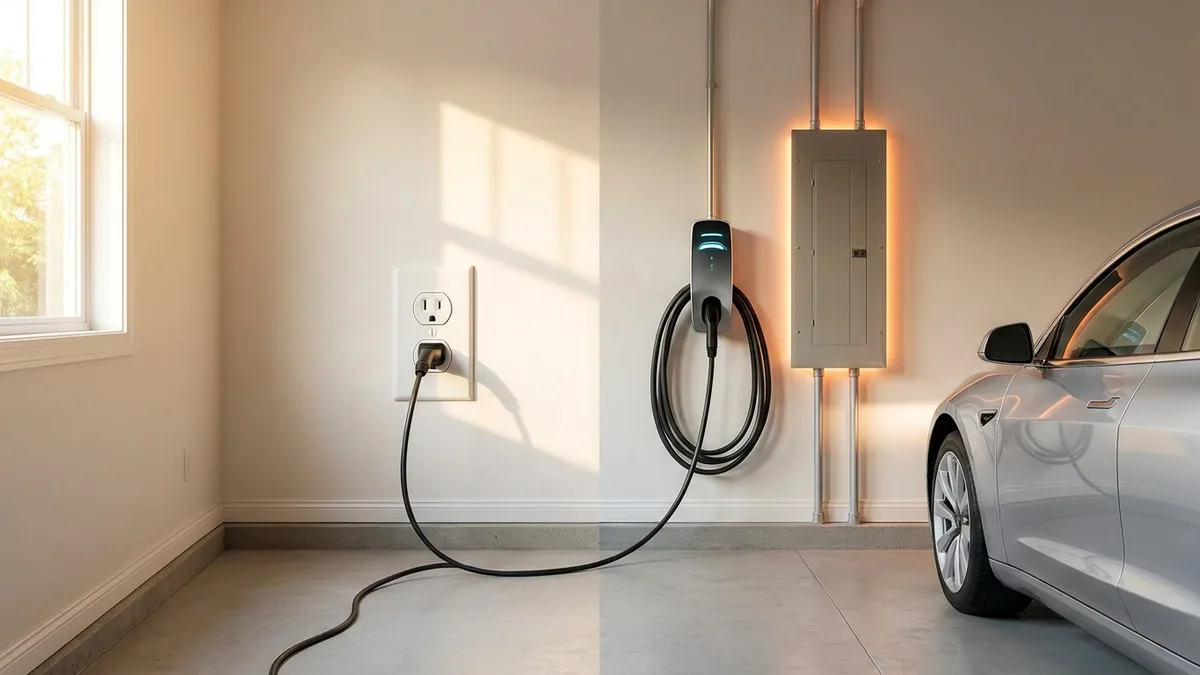
The difference comes down to voltage. Level 1 uses the standard 120-volt outlet already in your garage and adds roughly 3–5 miles of range per hour. Level 2 runs on a dedicated 240-volt circuit — the same class that powers an electric dryer or range — and adds about 20–30+ miles per hour, or 5–7× faster. If you drive an EV every day, Level 2 is almost always worth it. Level 1 is fine for a plug-in hybrid or a very short commute.
Level 1 vs. Level 2: the basics
Every electric vehicle sold in the U.S. comes with a Level 1 charging cord in the trunk. Plug it into a standard household outlet and it charges — slowly. That is Level 1: convenient because it needs no new equipment, limited because a 120-volt outlet can only deliver so much power.
Level 2 is the home-charging setup most EV owners eventually install. It uses a 240-volt circuit — the same voltage that runs your electric dryer, oven, or air conditioner — wired on its own dedicated line back to your electrical panel. That higher voltage is the whole story: more power in means more miles of range per hour.
There is also Level 3 (DC fast charging), but that is the commercial equipment you see at highway stations. It requires industrial-grade power that homes do not have, so for a residential garage the real decision is only ever Level 1 vs. Level 2.
The charger that hangs on your wall is technically "electric vehicle supply equipment" (EVSE). The actual charger is built into the car — the wall unit just delivers power to it safely. We’ll keep calling it a "charger" here because that’s what everyone calls it.
Charging speed, side by side
Here is the practical difference in the two things that matter most — miles of range added per hour, and how long a full charge takes.
| Level 1 | Level 2 | |
|---|---|---|
| Voltage | 120V (standard outlet) | 240V (dedicated circuit) |
| Range added per hour | ~3–5 miles | ~20–30+ miles |
| Full charge time | 20 to 40+ hours | Typically overnight |
| Equipment needed | None (uses the included cord) | Level 2 unit + dedicated circuit |
| Best for | Plug-in hybrids, short commutes | Daily EV drivers |
The numbers are approximate on purpose — actual speed depends on your specific vehicle, the charger’s amperage, and your car’s onboard charging limit. But the gap holds across the board: Level 2 is roughly 5 to 7 times faster than Level 1.
What that means in real life: plug a modern EV into a Level 1 outlet on Friday night and it may still not be full by Sunday. Plug the same car into a Level 2 charger and it goes from nearly empty to full while you sleep — so you leave every morning with a topped-off battery and never think about it.
Do the math on your own commute before you decide. If you drive 30 miles a day and your car sits in the garage 12 hours a night, Level 1 (~3–5 mi/hr) technically replaces what you used. The problem is margin: one long day, a cold snap that cuts range, or forgetting to plug in, and you’re behind with no way to catch up quickly. Level 2 buys back that margin.
Who actually needs Level 2
Not every driver does — so here is an honest split.
- You drive a plug-in hybrid with a small battery
- Your daily driving is short — under ~30 miles
- The car sits plugged in for many hours every night
- You have a second vehicle to fall back on
- Your EV is your primary daily vehicle
- You have a longer commute or run a lot of errands
- You want a full battery every morning without planning around it
- You have a full battery-electric car (not a plug-in hybrid)
- You’re tired of babysitting the Level 1 trickle
For most people who buy a full battery-electric vehicle, Level 2 is the practical choice. It turns home charging from a compromise into the most convenient fuel-up you’ll ever have — done in your own garage, at home electricity rates, while you sleep.
What a Level 2 install requires
A Level 2 install is a defined, permitted electrical job — not just bolting a box to the wall. Here is what goes into it.
A licensed electrician confirms where you want the charger, plans the circuit run, and checks that your electrical panel has room to add a 240-volt, 40–60-amp circuit. This step decides everything else.
Your charger gets its own dedicated circuit back to the panel — correctly breakered and wired for the charger’s amperage. No sharing with other outlets, no nuisance trips.
The unit is mounted and connected — either hardwired or on a NEMA 14-50 outlet, depending on your charger and preference — with a clean conduit run.
The electrical permit is pulled and the work is inspected by the local authority, so the install is documented and code-compliant — which protects you at resale and with your insurance.
Hardwired or plug-in (NEMA 14-50)? Both are valid. A hardwired unit is cleaner-looking and required for the highest-amperage chargers; a plug-in setup lets you unplug and take the charger with you if you move. Your electrician will match the method to your charger and your garage — it’s a decision worth making before the circuit is run, not after.
Need a Plumber or Waterproofing Expert?
Our team is available 24/7 for emergencies. Call now or schedule online.
Will your electrical panel keep up?
This is the part most homeowners miss — and the single biggest variable in a Level 2 install. A Level 2 charger is one of the largest loads you can add to a house. Your electrical panel has a fixed amount of capacity, and the new 40–60-amp circuit has to fit within it.
If you have a modern 200-amp panel with open breaker space, adding an EV circuit is usually straightforward. But if your home still runs on an older 100-amp service, a fuse box, or a panel that’s already near capacity, there may not be room for the new circuit. That is not a dealbreaker — it just means the charger goes in alongside an electrical panel upgrade to a 200-amp service, which a good electrician can often do in the same visit.
The key is checking capacity before the quote, not halfway through the job. A reputable installer confirms your panel can handle the load up front, so you never hear "your panel can’t take it" after the box is already on the wall.
Not sure what size service you have? Look at the main breaker at the top of your panel — the number stamped on it (100, 150, 200) is your service size in amps. If you can’t find it or you’re on an old fuse box, that’s worth a professional look before you buy a charger.
Cost and incentives, honestly
The honest answer is that installation cost depends on your home. The biggest factors are:
- Distance from your panel to the charger. A short run in an open basement is cheap; a long route through finished walls costs more.
- Your charger’s amperage. Higher-amperage chargers need heavier wire and larger breakers.
- Whether your panel has capacity. If it needs an upgrade first, that adds to the total.
A short, simple run near the panel is an affordable, often same-day job. A long run or a panel upgrade adds to it. That’s why any electrician worth hiring assesses your garage and panel first and gives you a flat, upfront price — not an hourly guess.
Federal EV-charger tax credits and Ohio utility programs do exist, but they come and go, and eligibility depends on your provider and location. Check what’s currently available before you buy — but budget for the install on its own merits, so the number stands whether or not an incentive applies. Don’t let a rebate you’re not sure you qualify for drive the decision.
Choosing a charger
Once you’ve settled on Level 2, picking the actual unit comes down to a few things.
| What to check | Why it matters |
|---|---|
| Amperage (32A / 40A / 48A+) | Higher amperage charges faster — but only up to your car’s onboard limit and what your panel can support. There’s no point paying for 48A if your vehicle caps at 32A. |
| Connector type | Most chargers use the universal J1772 plug; Tesla vehicles use their own connector (with adapters widely available). A Tesla Wall Connector is purpose-built for Tesla vehicles. |
| Hardwired vs. plug-in | Hardwired is cleaner and needed for the highest amperage; plug-in lets you take it with you. |
| Smart features | Wi-Fi, scheduling, and app control let you charge during off-peak electricity hours — nice to have, not essential. |
| Indoor vs. outdoor rating | If the charger will live on an exterior wall, it needs a weather-rated enclosure. |
Match the charger to your car and your panel — not to the biggest number on the box. A licensed electrician can tell you the fastest charger your vehicle can actually use and your panel can actually support, so you don’t overspend on capacity you’ll never touch. If you haven’t bought a charger yet, ask before you order.
Whichever unit you choose, the wiring behind it is what makes it safe and fast. A quality charger on an undersized or improperly installed circuit is the worst of both worlds — which is why the install matters as much as the hardware.
Frequently asked questions
Can I just use the cord that came with my EV?
Yes — that’s the Level 1 cord, and it plugs into any standard 120-volt outlet. It adds about 3–5 miles of range per hour, which is enough for a plug-in hybrid or a short commute with lots of overnight charging time. For a full battery-electric car driven daily, most owners find it too slow and upgrade to Level 2.
How much faster is Level 2 than Level 1?
Roughly 5 to 7 times faster. Level 1 adds about 3–5 miles of range per hour; Level 2 adds about 20–30+ miles per hour on a dedicated 240-volt circuit. In practice, Level 2 takes an EV from nearly empty to full overnight, while Level 1 can take a full day or more.
Do I need a special circuit for Level 2?
Yes. A Level 2 charger needs its own dedicated 240-volt circuit — the same class of circuit as an electric dryer or range — wired back to your electrical panel and breakered for the charger’s amperage. That dedicated circuit is what lets it charge fast and safely without tripping breakers.
Will my electrical panel handle an EV charger?
That’s the first thing to check. A Level 2 charger is a large load, and older 100-amp panels or fuse boxes often don’t have room for the new circuit. If yours doesn’t, the install can be paired with a 200-amp panel upgrade — ideally confirmed before you get a quote, so there are no surprises.
Can a Level 2 charger be installed the same day?
Often, yes. A short, simple circuit run near the panel is frequently a same-day job. Longer runs through finished walls, or installs that require a panel upgrade first, take longer. A proper assessment tells you which situation you’re in before any work starts.
Is it safe to install an EV charger myself?
Adding a 240-volt, 40–60-amp circuit is serious electrical work that requires a permit and inspection in most jurisdictions. Done wrong, it’s a fire risk and can void your charger’s warranty and your homeowner’s insurance. This is a job for a licensed electrician who pulls the permit and has the work inspected.
Thinking about Level 2 charging at home?
AK Water Works installs Level 2 EV chargers and Tesla Wall Connectors on dedicated circuits across Warren, Youngstown, Boardman, Niles, and the Mahoning Valley — panel capacity checked first, permit pulled, flat price up front.
Electrical services provided by Alliance Trade Group LLC, OH Electrical License #38179.
Need Help With Your Plumbing?
Our team is ready to help with any plumbing or waterproofing need.
Related Articles
Prep Your Home Electrical System for Winter Storms
A Northeast Ohio winter tests your home's electrical system with outages, ice, and overloaded space heaters. Here's the prep checklist that keeps the lights, the furnace, and the sump pump running.
Read More
Is Your Older Warren-Area Home Due for Rewiring? Knob-and-Tube & Aluminum Wiring
Older Warren-area homes often hide knob-and-tube or aluminum wiring never built for a modern electrical load. How to spot it, the fire and insurance risks, and what a rewire involves.
Read More
Do You Need a Whole-Home Generator in Northeast Ohio?
Northeast Ohio storms and ice knock out power every year. Here's how to decide if a whole-home standby generator is worth it for your Warren-area home, what it protects, sizing basics, and who does what.
Read More