
Best Battery Backup Sump Pumps for NE Ohio Homes (2026 Guide)
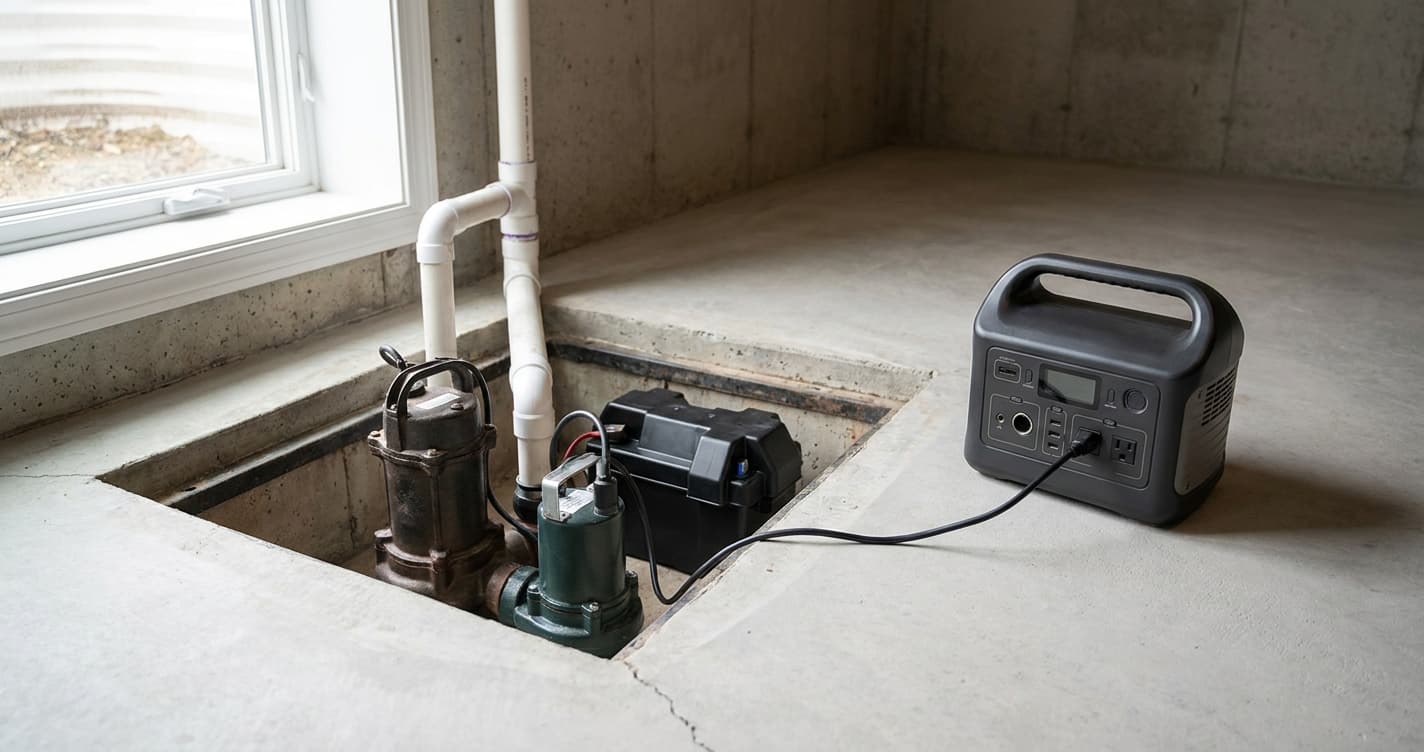
In Northeast Ohio, our worst power outages arrive during the exact spring storms that overwhelm sump pits — so a sump pump without backup is a flooded basement waiting to happen. For fully automatic protection, a dedicated battery backup sump pump (Zoeller Aquanot, Basement Watchdog, Wayne, or Liberty StormCell) is the gold standard. A portable power station with at least 2,000 running watts and 3,000+ surge watts (EcoFlow, Bluetti, Jackery) can also keep a pump running — and cover your fridge and furnace at the same time. AK Water Works installs, sizes, and tests both across Trumbull, Mahoning, and Portage counties.
Why a Battery Backup Isn’t Optional in Northeast Ohio
Most sump pump failures don’t happen because the pump broke. They happen because the power went out — and in the Mahoning Valley, the power tends to go out at the worst possible moment.
The heavy rain and wind events that knock out Ohio Edison service across Trumbull and Mahoning counties are the same storms that dump water on our clay-heavy soil. That clay doesn’t drain — it holds water against your foundation and forces it into the sump pit under pressure (the same hydrostatic pressure that makes basements flood here in the first place). So the instant your pump loses power, your pit is filling faster than any other time of year, and a finished basement can take on water within an hour or two.
We break down the full picture in our guide to why Trumbull & Mahoning County basements flood — and if yours already has water in it, start with what to do in the first hour.
A standard sump pump has three single points of failure: the grid, the motor, and the float switch. A battery backup adds a second pump on a second power source — the single most valuable upgrade you can make to a basement waterproofing system in this climate.
Spring is when it matters most. Between March and May, our region stacks up melting snowpack, the heaviest rain of the year, and still-frozen ground that can’t absorb the runoff. That combination is why AK Water Works fields more flooded-basement calls in those weeks than any other time — and why we treat a backup pump as core maintenance and a standard part of a complete basement waterproofing system, not an optional upgrade.
| Season in NE Ohio | Why Your Pump Runs Hard | Outage Risk |
|---|---|---|
| Spring (Mar–May) | Snowmelt + heaviest rain + frozen ground | Highest — thunderstorms & wind |
| Summer | Fast, heavy downpours overwhelm drainage | High — severe storms |
| Fall | Steady soaking rains raise the water table | Moderate — wind events |
| Winter | Thaw cycles + ice-related grid faults | Moderate — ice & heavy snow |
What Separates a Good Backup From a Bad One
Battery backup systems are not created equal. Before you compare models, know what actually matters:
What to Look For
The Best Battery Backup Sump Pump Systems for 2026
These are the systems we see hold up in real Northeast Ohio basements — ranked by what they’re best at. Any of them is a system we can install, size, and service.
| System | Battery | Backup Output (approx. @10 ft) | Best For |
|---|---|---|---|
| Zoeller Aquanot 508/509 | AGM | ~1,000–1,300 GPH | Overall reliability |
| Basement Watchdog Big Combo | AGM | ~1,000 GPH | Best monitoring |
| Wayne WSSM40 / ESP25 | AGM | ~1,000–1,500 GPH | Highest output |
| Liberty StormCell SJ10 | AGM | ~1,100 GPH | Pro-grade durability |
| PumpSpy Wi-Fi | AGM | ~1,000 GPH | Remote text alerts |
1. Zoeller Aquanot 508/509 — Best Overall
Zoeller is the name most plumbers reach for, and the Aquanot line is why. It pairs a strong AGM-powered backup pump with smart controls that continuously monitor the battery and self-test. As a combination system (the ProPak versions include the primary pump too), it’s a clean, matched setup rather than a mismatched add-on. If you want one system and don’t want to think about it again, this is the safe pick.
2. Basement Watchdog Big Combo — Best Monitoring
Basement Watchdog built its reputation on telling you before something goes wrong. The controller tracks fluid level, battery health, and pump activity, with a clear alarm panel. The Big Combo bundles a primary and battery backup pump together. For homeowners who’ve been burned by a silent failure, the visibility here is the selling point.
3. Wayne WSSM40 / ESP25 — Highest Output
When a pit fills fast — think a low lot near the Mahoning River or a home that’s taken on water before — raw pumping capacity buys you time. Wayne’s backup units are among the strongest movers in the category, and the ESP25 is a well-regarded workhorse. Good choice for high-water-table homes — the kind we see in Warren, Niles, and low-lying Youngstown neighborhoods.
4. Liberty StormCell SJ10 — Best Pro-Grade
Liberty Pumps is a contractor favorite for a reason: the StormCell is built to be serviced and to last. Solid output, a well-designed controller, and the kind of durability that holds up to years of NE Ohio spring seasons. If you want commercial-grade parts in a residential pit, start here.
5. PumpSpy Wi-Fi — Best for Alerts & Rentals
PumpSpy’s edge is connectivity: it texts and emails you when the power drops, the water rises, or the battery weakens — and it can alert a monitoring service. If you own a rental, travel often, or simply never want to walk down to a surprise, the remote peace of mind is worth the premium.
Whatever brand you choose, the battery is the part that ages. An AGM battery quietly loses capacity over 3–5 years, so a system that tested fine three springs ago may not last a full outage today. Replace on a schedule, not after a failure.
The No-Battery Alternative: Water-Powered Backup
There’s one backup type that never needs charging: a water-powered backup pump (such as the Zoeller 540 or a Basepump unit). It uses your home’s municipal water pressure to create suction and move water out of the pit — no battery, no motor, nothing to wear out or run down.
- Unlimited runtime — runs as long as the outage lasts, even for days
- No battery to replace or monitor
- Excellent as a true last-resort layer
- Needs strong city water pressure — not an option on a private well
- Uses roughly 1–2 gallons of city water per gallon pumped
- Lower output than a strong battery unit
If your home is on city water (most of Warren, Niles, Youngstown, and Boardman), a water-powered backup makes a superb second line of defense — because a multi-day outage is exactly when a battery finally dies. If you’re on a well, skip it and put your budget into a strong battery system plus a power station.
Portable Power Stations That Can Run a Sump Pump
Here’s the option most homeowners don’t realize they have: a modern portable power station (a large lithium battery with a built-in inverter) can absolutely run a sump pump — and unlike a dedicated backup, it can also keep your refrigerator, furnace blower, and phones alive during the same outage. But there’s a catch you have to get right.
Need a Plumber or Waterproofing Expert?
Our team is available 24/7 for emergencies. Call now or schedule online.
The surge problem — the number that actually matters
A sump pump is an electric motor, and motors draw a big startup surge the instant they kick on — often 2–3x their running wattage for a fraction of a second. If the power station can’t deliver that surge, the pump won’t start and the station will fault. So you size for the surge, not the running watts.
| Pump Size | Running Watts | Startup Surge | Minimum Power Station |
|---|---|---|---|
| 1/3 HP | ~800–1,050 W | ~2,000–2,400 W | 2,000 W run / 3,000 W surge |
| 1/2 HP | ~1,050–1,300 W | ~2,500–3,000+ W | 2,400 W run / 3,600 W surge |
Two non-negotiables: the inverter must be pure sine wave (all the stations below are), and you should trust the unit’s native surge rating — not a “boost” mode. Features like EcoFlow’s X-Boost are designed for resistive loads (heaters, kettles) and can lower voltage to fit them; a motor needs real surge headroom, not a workaround.
Power stations that comfortably run a sump pump
| Power Station | Continuous / Surge | Capacity | Notes |
|---|---|---|---|
| EcoFlow Delta 2 | 1,800 W / 2,700 W | ~1,024 Wh | Entry point for a 1/3 HP pump; add a battery for capacity |
| Bluetti AC200L | 2,400 W / 3,600 W | ~2,048 Wh | Great all-around; strong UPS mode |
| Jackery Explorer 2000 Plus | 3,000 W / 6,000 W | ~2,042 Wh | Huge surge headroom; expandable |
| EcoFlow Delta Pro | 3,600 W / 4,500 W | ~3,600 Wh | Whole-basement + whole-home resilience |
| Anker SOLIX F3800 | 6,000 W / 9,000 W | ~3,840 Wh | Overkill for the pump, ideal for the whole house |
The trick that makes it automatic: UPS / pass-through mode
A power station only saves your basement if it’s actually powering the pump when the grid fails. The best models solve this with UPS (pass-through) mode: you plug the sump pump into the station, and the station into the wall. Grid power passes straight through to the pump — until the power drops, when the station takes over in as little as 20–30 milliseconds. Fast enough that the pump never notices.
Set up in UPS mode, a power station becomes a near-automatic backup and a whole-home battery you can wheel to the fridge or furnace. Add a solar panel and it can recharge during a long daytime outage — something a sealed sump battery can’t do.
A power station is a fantastic layer, but it isn’t a substitute for a dedicated backup pump. If it’s not pre-staged in UPS mode, someone has to be home to plug it in — and a long, multi-day outage will eventually drain any battery. The most storm-proof basements in our service area have both: a dedicated battery backup pump for hands-off protection, and a power station for everything else.
What Size Do You Actually Need?
The right setup depends on your pit, your lift height, and your history. A quick way to think about it:
If your primary pump is 1/2 HP, don’t back it up with a token 1/4 HP unit. The backup should be able to keep up when it’s the one carrying the storm.
Count the vertical feet from the pump to where the discharge exits, then add the horizontal run. Deeper basements in Warren and Youngstown often need 9–10 feet of lift — that’s where weak backups fall short.
If your basement has flooded before or your pump cycles constantly in spring, size up — a higher-output backup (Wayne) or a power station that can also run a second pump.
Travel, own a rental, or have a finished basement? Choose a Wi-Fi system (PumpSpy) or a power station that reports its status, so a dead battery never surprises you.
Why Professional Installation Matters
The pump is only half the system. Most backup failures we’re called out to fix in Trumbull and Mahoning counties trace back to the install, not the equipment:
⚠ What Goes Wrong With DIY Backups
When AK Water Works installs a battery backup or sets up a power-station UPS for your sump pump system, we size it to your pit and lift height, wire the floats for independent triggering, verify the check valve and discharge, and test it under load before we leave. A backup pump also works best as one layer of a system — alongside interior perimeter drainage and foundation crack repair — so we look at the whole basement, not just the pit. We’re a family-owned, Warren-based team that fixes flooded NE Ohio basements every week, across Trumbull and Mahoning counties, so we build the backup for the storms we actually get.
A battery backup is the automatic first responder; a whole-home standby generator is the long-outage solution. Many homeowners in our area pair a battery backup pump with backup power for the whole house — and our sister company in the Warren-based AK family, AK Heating & Cooling, handles Generac standby generators if that’s the direction you’re headed.
Frequently Asked Questions
A healthy AGM system typically delivers 5–7+ hours of continuous pumping, or roughly 1–3 days of normal on-and-off cycling, on a full charge. Real runtime depends on how hard the pump is working and the battery’s age — capacity fades over 3–5 years, which is why a system that lasted a full outage two springs ago may not today.
Yes — as long as it has a pure sine wave inverter and enough surge capacity for the motor’s startup spike. For a 1/3 HP pump, look for at least 2,000 running watts and 3,000 watts of surge; for a 1/2 HP pump, step up to about 2,400 running / 3,600 surge. Set it up in UPS (pass-through) mode and it can take over automatically the instant the grid drops.
Size for the surge, not the running watts. A Bluetti AC200L (2,400 W / 3,600 W surge) or Jackery Explorer 2000 Plus (3,000 W / 6,000 W surge) comfortably starts and runs most residential pumps, with capacity left over for a fridge and phones. An EcoFlow Delta 2 is a workable entry point for a 1/3 HP pump.
AGM (sealed lead-acid) is proven and affordable but lasts 3–5 years and needs periodic replacement. Lithium costs more up front but runs longer per charge and lasts many more cycles. For a dedicated backup pump, AGM is still the mainstream choice; if you want lithium’s longevity and flexibility, a lithium power station in UPS mode is often the better way to get it.
They solve different problems. A water-powered backup runs indefinitely but needs strong city water pressure and moves less water; a battery unit pumps harder but eventually runs down. On city water, running both is the most bulletproof setup. On a well, a water-powered backup isn’t an option — go with a strong battery system plus a power station.
Yes — a standby generator will power the pump along with the rest of the house, but there’s a short gap between the outage and the generator starting. That’s why we still recommend a battery backup or a UPS-mode power station as the instant first responder, with the generator carrying the long haul.
Plan on every 3–5 years for AGM, and test it each spring before storm season. A battery that reads fine at rest can still collapse under load, so a real load test — which we perform on every service visit — is the only reliable check.
Protect Your Basement Before the Next Storm
AK Water Works installs, sizes, and tests battery backup sump pumps and power-station setups across Warren, Youngstown, Niles, Boardman, and all of Northeast Ohio. Free inspections, satisfaction guaranteed, and financing available.
Need Help With Your Plumbing?
Our team is ready to help with any plumbing or waterproofing need.
Related Articles

Why Trumbull & Mahoning County Homes Are Prone to Basement Flooding (And What to Do About It)
If you've lived in Trumbull or Mahoning County for any length of time, you probably know someone whose basement floods. It's not bad luck — it's geology, history, and aging infrastructure. Here's what's really happening, and what local homeowners can do about it.
Read More
Why Does My Basement Flood When It Rains? Causes & How to Fix It for Good
A basement that floods every time it rains isn't just inconvenient — it's actively damaging your home's structure, your belongings, and your air quality. Here are the six most common causes and what actually fixes each one.
Read More
The Importance of Professional Waterproofing for Boardman Ohio Basements
Professional waterproofing in Boardman, Ohio, is crucial due to the challenging weather conditions, including heavy rainfall and freeze-thaw cycles, which can compromise basement integrity. AK Water Works offers customized solutions utilizing advanced techniques to provide long-lasting protection ag
Read More