
AC Not Cooling? 5 Checks to Do Before You Call
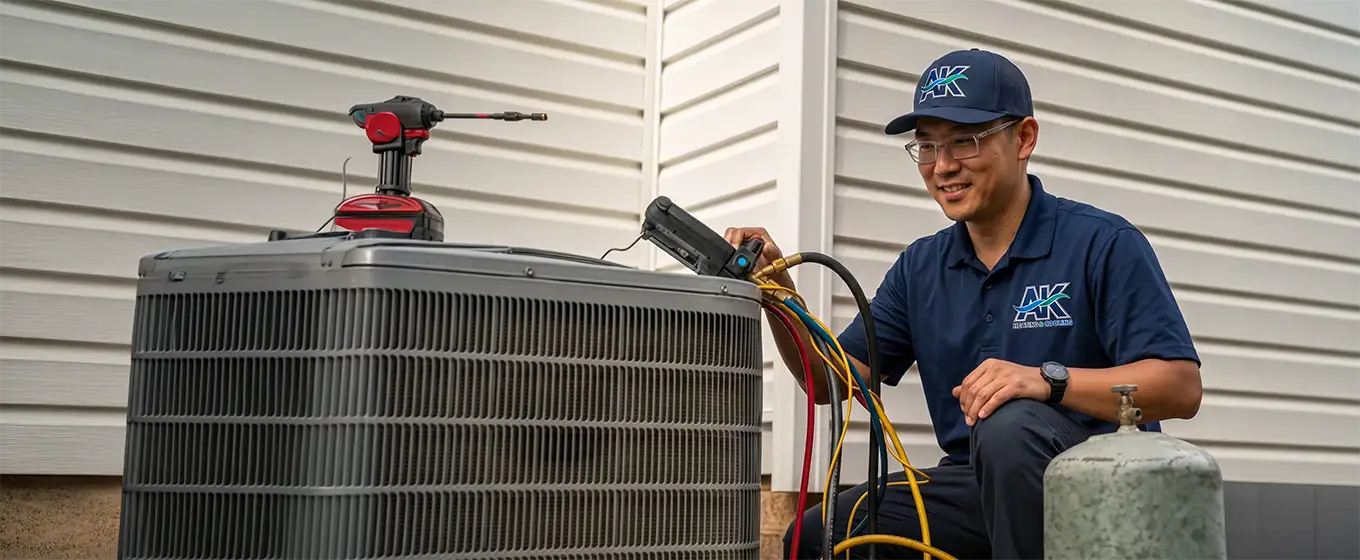
When your AC runs but the house stays warm, check five things first: the thermostat setting, the air filter, ice on the lines, the breakers, and the outdoor unit. Together they take about 15 minutes and need no tools. If the AC still does not cool, or a breaker trips a second time, stop and call a pro. Never open the outdoor unit’s panels or add refrigerant yourself.
First: Is It Broken, or Just a Very Hot Day?
A normal July afternoon at the Youngstown-Warren airport tops out at about 83°F, per the National Weather Service normals. Home AC systems here are sized for normal Valley summers, not for the hottest day of the year. On a 90°F-plus day, a healthy AC can run without a break and still leave the house a few degrees above the setting. That is not a failure.
A quick test tells you more than the thermostat number does:
This is a rough home check, not a diagnosis. Very humid days and very long runs can change the number. It is most useful to tell “working hard” from “not working.”
Check 1: The Thermostat
It sounds too simple, but a thermostat setting is behind a lot of “broken AC” calls. Check each item:
Thermostat checklist
After you change a setting or the power comes back, wait about 5 minutes. Many systems have a built-in delay that protects the outdoor compressor. Turning the thermostat on and off again during that time only resets the wait.
Check 2: The Air Filter
The filter sits in a slot at the furnace or air handler, or behind a return grille. Pull it out and hold it up to a light. If you cannot see light through it, replace it.
A clogged filter chokes airflow. Weak airflow makes the indoor coil too cold, and it can freeze (see Check 3). The U.S. Department of Energy says that replacing or cleaning a dirty filter can lower an AC’s energy use by 5–15% (DOE Energy Saver). ENERGY STAR says to check the filter every month during cooling season.
- Match the size printed on the old filter frame.
- Point the airflow arrow toward the furnace.
- Open closed supply vents. Make sure furniture or rugs do not cover the return grilles.
- Running the system with no filter “to get more air.” Dust goes straight onto the coil.
- Closing vents in unused rooms to push air elsewhere. It lowers total airflow.
If some rooms stay hot while others are fine, the cause is often the ducts, not the AC. Our ductwork team can check for disconnected or crushed runs.
Check 3: Ice on the Lines or Coil
Go to the outdoor unit and look at the two copper lines that run into the house. The larger one is covered in black foam. Also look at the indoor coil box on top of the furnace, if you can see it. Frost or ice on either one means the system has frozen up. A frozen AC cannot cool, no matter how long it runs.
Do not chip or scrape ice off the coil or lines. The coil fins and copper are thin and easy to puncture. If the ice comes back with a clean filter, the cause is usually low refrigerant or a blower problem. That needs a technician.
Check 4: Breakers and Switches
A central AC has two power points. The outdoor unit has its own double breaker in your panel, often labeled AC, A/C or condenser. The indoor blower runs on the furnace or air handler circuit. Summer storms and power flickers can trip either one.
If the breaker trips again, do not reset it a second time. A breaker that trips again is doing its job. It is telling you something is drawing too much power, such as a failing compressor, a bad capacitor or a shorted wire. Resetting it again and again can damage the compressor and is a fire risk.
If your lights dim or flicker each time the AC starts, read our guide on lights that flicker when the AC turns on. It explains which flicker is normal and which is not.
Need a Plumber or Waterproofing Expert?
Our team is available 24/7 for emergencies. Call now or schedule online.
Check 5: The Outdoor Unit
With the AC calling for cooling, go outside and look and listen.
| What you see or hear | What it likely means | Your move |
|---|---|---|
| Fan spins, unit hums steadily | Outdoor unit is running | Check for blocked fins (below) |
| Unit is silent and still | No power or no signal from the thermostat | Recheck Checks 1 and 4 |
| Unit hums or buzzes, but the fan does not spin | Often a failed capacitor or fan motor | Turn the AC off at the thermostat and call |
| Clicking on and off every few minutes | Short cycling (control, pressure or electrical fault) | Turn it off and call |
| Grinding, screeching or banging | Mechanical failure in the fan or compressor | Turn it off and call |
Clear the fins
The outdoor unit pushes heat out through thin metal fins on its sides. If they are covered, heat stays in your house. In the Valley, the usual problems are cottonwood fluff in June, grass clippings from the mower, and leaves in the fall. Shrubs that grow close to the unit block air too.
Do not remove the outdoor unit’s side panels or top. The capacitor inside can hold a dangerous electrical charge even after the power is off. Leave anything behind a panel to a technician.
A yearly cleaning keeps the fins clear before the first heat wave. See our spring AC clean and check-up.
When to Stop and Call a Pro
The five checks above are all safe for a homeowner. Past this point, the work needs tools, training and, for refrigerant, a federal license.
⚠ Call a technician if:
Why you cannot just “add Freon”
Under the federal Clean Air Act, only EPA Section 608 certified technicians can buy refrigerant for home AC systems. There is also a practical reason. An AC does not use up refrigerant. If it is low, it is leaking. Adding more without finding the leak only buys time.
Do not wait for diagnostics on a heat-advisory day if someone at home is elderly, very young or medically fragile. Move them to a cool room or a cooling center, then call. Our emergency HVAC service covers no-cooling calls.
What to Tell Us When You Call
The checks you just did save time on the service call. Have these ready:
Have this ready
Have a heat pump instead of a central AC? In summer it cools the same way, and the same five checks apply. See our heat pump service page.
For repairs, replacements and tune-ups, see our AC repair and installation page.
Frequently Asked Questions
The most common causes are a clogged filter, a frozen coil, a dirty outdoor unit, or the outdoor unit not running at all while the indoor fan does. Check the thermostat, filter, ice, breakers and outdoor unit, in that order. If those are fine, the cause is likely refrigerant or an electrical part, which needs a technician.
First check that the thermostat fan is on AUTO, not ON. On ON, the blower keeps running between cooling cycles and moves room-temperature air. If the fan is on AUTO and the air is still warm, check whether the outdoor unit is running. If it is silent, check the AC breaker.
Yes. Set the thermostat to OFF and the fan to ON so the ice melts. Replace the filter. When the ice is fully gone, turn cooling back on. If it freezes again, call a technician.
About 5 minutes. Many systems delay the outdoor compressor after a power change to protect it. If nothing starts after 10 minutes with the thermostat on COOL and set below room temperature, move on to the breaker checks.
No. Federal rules allow only EPA Section 608 certified technicians to buy refrigerant for home AC systems. Low refrigerant also means a leak, and the leak needs to be found and fixed.
On the hottest days, a healthy AC may run nonstop and still sit a few degrees above the setting. Use the vent test instead of the thermostat number: supply air about 15–20°F cooler than return air usually means the system is working.
AK’s heating and cooling work comes from AK Heating & Cooling, our sister company in the Warren-based AK family. Calls to (330) 574-1507 reach the AK HVAC team.
Did the Checks and Still No Cool Air?
Call AK and tell us what you found. We serve Warren, Niles, Cortland, Howland, Youngstown, Austintown, Boardman, Canfield and the rest of Trumbull and Mahoning counties.
Need Help With Your Plumbing?
Our team is ready to help with any plumbing or waterproofing need.
Related Articles
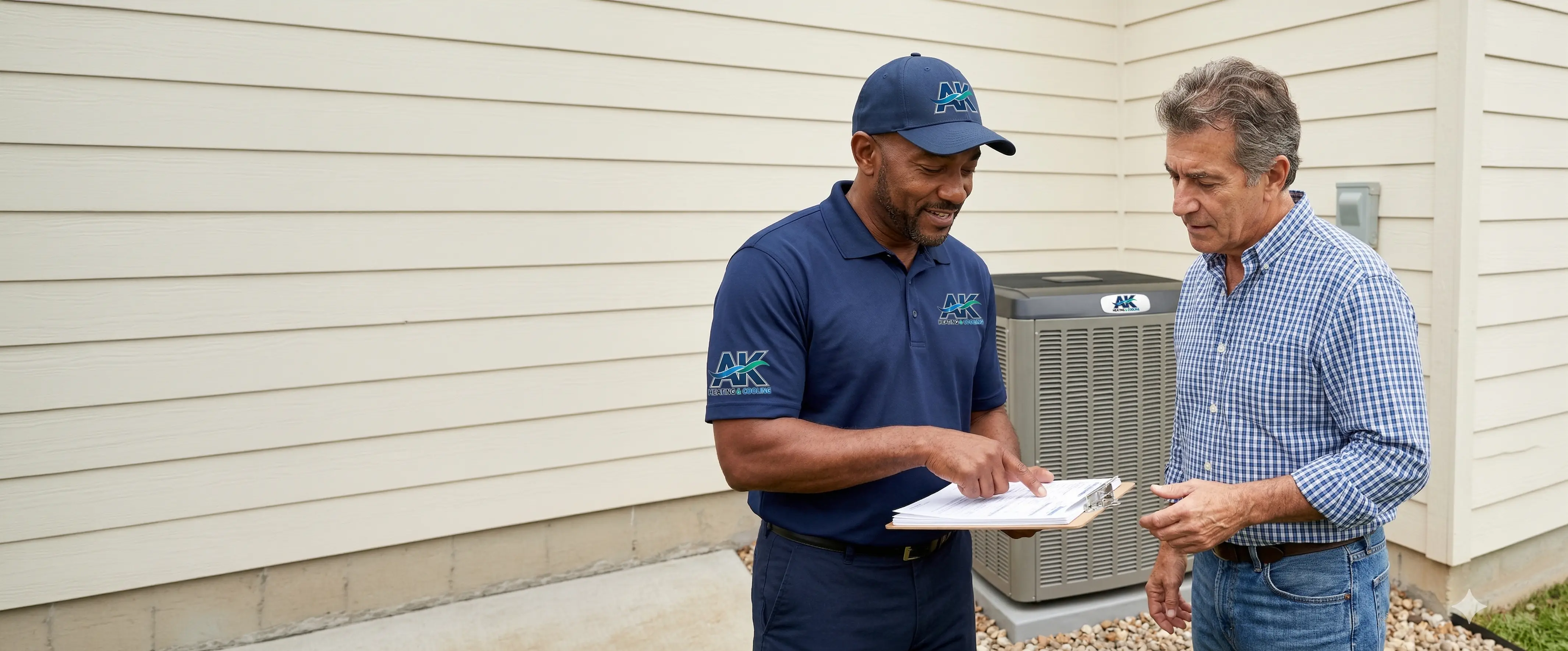
Heat Pump vs Furnace: Which Heats a NE Ohio Home for Less?
A cold-climate heat pump can heat a Valley home through a normal winter, with backup heat for the coldest nights. Here is how each system works and which one fits your house.
Read More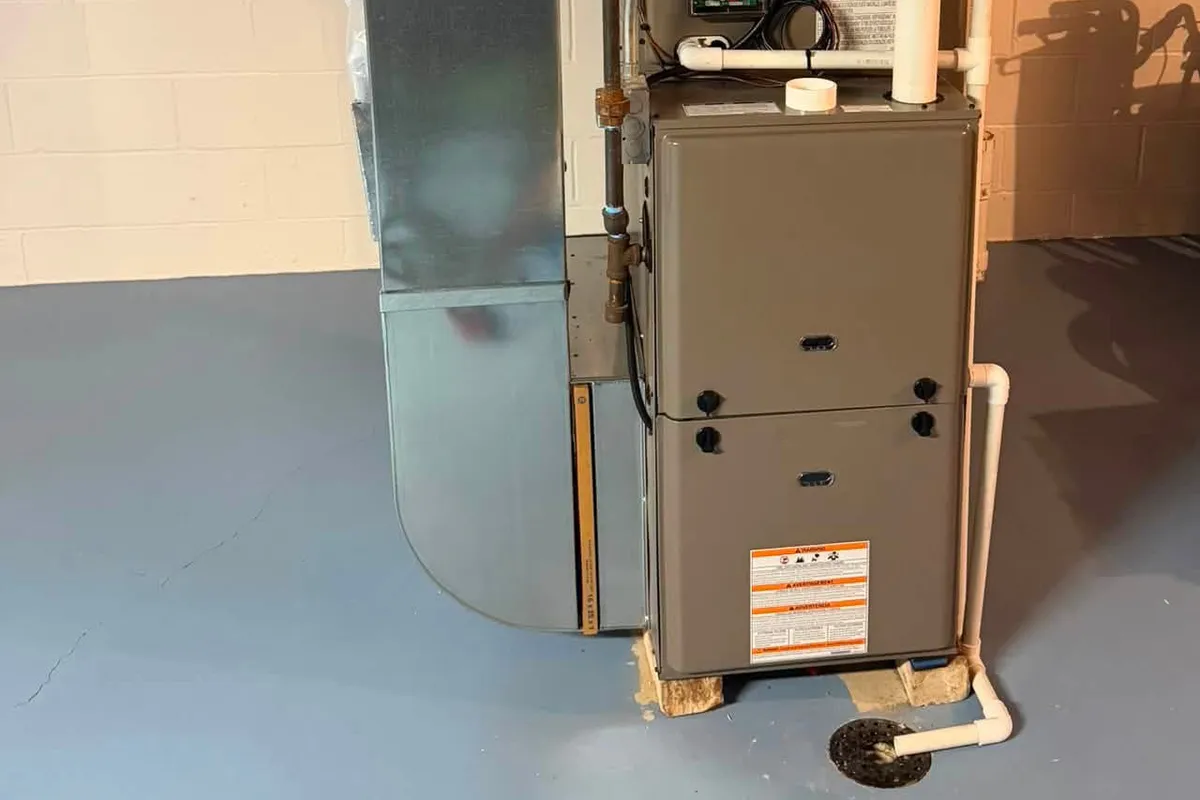
Is a High-Efficiency Furnace Worth It? What It Does to Your Gas Bill
A 96% furnace burns about 17% less gas for heat than an 80% one, and about 27% less than a 70% one. Here is how to work out what that means on your own gas bill.
Read More
HVAC in Austintown, Ohio: Furnace Install, AC Repair & 24/7 Heating and Cooling
Austintown homes face a heating and cooling workload most of Ohio doesn't — 40°F temperature swings, clay-soil basements, and 1960s ductwork running through 2020s demands. Here's the full picture of HVAC in Austintown: furnace install pricing, AC repair timing, heat pump options, and what to expect from a 24/7 heating and cooling company that actually shows up.
Read More