
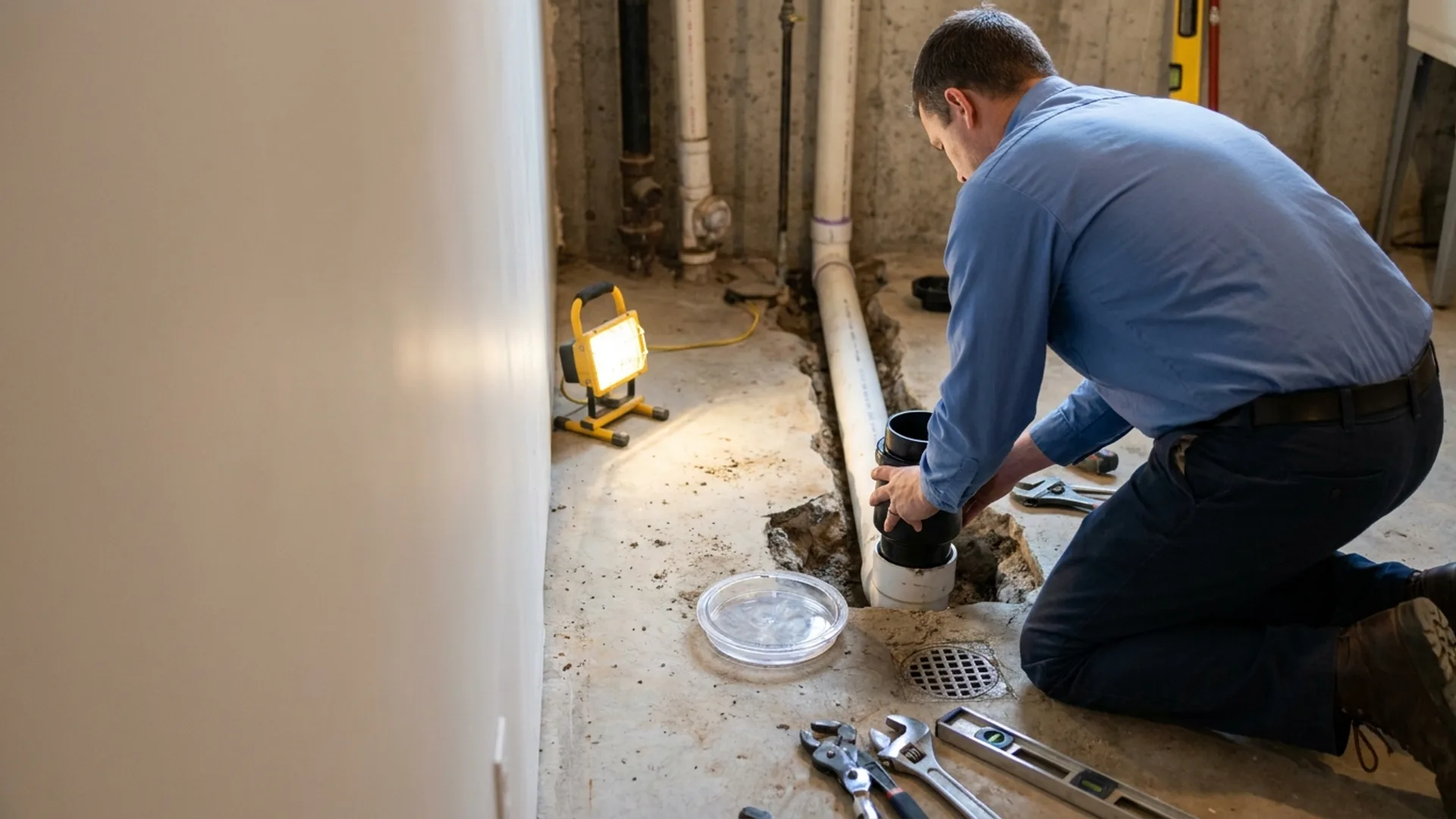
Backwater Valve Installation Keep the City Sewer Out of Your Basement.
Backwater valve installation puts a one-way check valve in your sewer lateral so that when the municipal main surcharges, sewage cannot push back up through your basement floor drain. We camera the line first, pull the permit, and build in access so the valve can actually be serviced.
Worth saying plainly: a backwater valve is a sewer backflow valve, and it protects you from the city side of the pipe. It is not a fix for a clog on your own line, and it is not waterproofing. We will tell you which problem you have before we sell you a valve.

Backwater valve installation is the one repair that addresses a very specific and very ugly problem: the municipal sewer fills up faster than it can drain, pressure has to go somewhere, and the lowest opening on the street is the floor drain in your basement. AK Water Works installs sewer backwater valves for homes across Warren, Youngstown, Boardman, Niles, and the rest of Trumbull, Mahoning, and Portage counties. The valve sits in your lateral, stays open for normal flow, and closes against reverse flow from the main.
If you have already had one basement sewer backup, you know why people call about this. Cleanup, contents, drywall, and flooring add up fast, and sewer backup is commonly excluded from a standard homeowners policy unless a rider was added. A valve is a physical preventive measure that does not depend on paperwork. Call (330) 574-1507 and we will camera the lateral and tell you whether a valve is the right call.
What Backwater Valve Work Includes
Backwater Valve Installation
One-way valve cut into the sewer lateral
Camera Inspection First
We confirm the line is sound before we add a valve
Valve Repair & Replacement
Stuck flapper, broken gate, cracked body
Cleanout Access & Risers
Serviceable access so the valve can be inspected
Floor Drain & Fixture Review
Every opening below street level checked
Permits & Inspection
We pull the permit and meet the inspector
Sewer Backup Prevention Services We Handle
Backwater valve installation, valve repair, cleanout access, and camera inspection of the sewer lateral.
- Backwater valve installation
- Backwater valve inspection
- Sewer backflow prevention

Had Sewage Come Up a Floor Drain?
We camera the lateral first, then tell you whether a backwater valve is the right fix.
Why Homeowners Call Us for This
Signs You Should Be Asking About a Valve
When a Backwater Valve Makes Sense
Not every house needs one. The homes that benefit most have an opening below the level of the street, which is where surcharging sewage will always come out first.
Fixtures below street level
A basement floor drain, laundry standpipe, basement toilet, or shower sitting below the crown of the city main is the path of least resistance. Older homes here often have all four. If your only plumbing is on the first floor and above, your exposure is much lower.
Combined sewers and heavy rain
Plenty of older neighborhoods in this part of Ohio were built on combined systems that carry storm water and sanitary flow in the same pipe. When a hard rain fills that pipe, the whole street surcharges at once. If your backups line up with storms rather than with slow drains, that is the pattern a valve is built for.
History and topography
A house that has backed up before will back up again under the same conditions. So will the low house on a hill, or the low lot on a street where neighbors have had the same trouble. Repeat events on a sound lateral are the clearest case for a valve.
Sewer Backup and Your Insurance
This surprises people at the worst possible moment: standard homeowners policies commonly exclude damage from sewer and drain backup. Coverage usually has to be added on as a separate endorsement or rider, and when it is added it often comes with a dollar cap that a finished basement can blow through easily. Terms vary by carrier and by policy, so read yours and call your agent rather than taking anyone else's word for it.
We are plumbers, not agents, so we will not tell you what your policy says or promise you a premium discount. What we will say is that a backwater valve is a physical preventive measure. It works on the pipe, not on the paperwork, and it keeps doing its job whether or not the rider is in place. If your basement has finished living space, having both the valve and the coverage is the sensible position.
How the Installation Goes
Camera the Lateral
Condition, depth, material, and the best access point
Locate the Line
Trace and mark the lateral, then call in utility locates
Quote It
One upfront price, permit included, before we dig
Cut In the Valve
Open the cleanout or excavate, then set the valve body
Backfill & Restore
Compact the trench and put the surface back
Camera Again
Verify flow and seating, then walk you through service access
Jack says: "A valve you cannot open is a valve you cannot trust. Build the access in, then check the flapper once a year."
What a Backwater Valve Will Not Do
A valve solves one problem well and nothing else. Knowing the difference saves you from paying for the wrong repair.
It will not clear your own clog
If the blockage is on the house side of the valve, roots, grease, or a bellied pipe, the valve is downstream of the problem and cannot help. In fact a closed valve can make a house-side clog back up faster. That is a cleaning or repair job.
It will not stop groundwater
Clean water seeping through a wall crack, a cove joint, or a window well is not sewage and has nothing to do with the sewer. That water comes from the soil around your foundation, and the fix is drainage, a sump system, or sealing the exterior.
It will not maintain itself
Wipes and grease can hold a flapper partway open, and a flapper that cannot seal is decoration. Open the access cap once a year, clear the seat, and confirm the flapper swings free. We show you how before we leave.
Looking for Backflow Testing on Your Water Supply?
That is a different service. This page is about a backwater valve on the sewer line, which keeps waste water from coming back into the building. Backflow prevention assembly testing covers an RPZ or DCVA device on the potable water supply, protecting drinking water from cross-connection, and it is a certified annual test required mostly on commercial buildings and irrigation systems.
We do both. If you were sent here about an annual backflow test notice, that work lives with our commercial team.
Backwater Valve Questions
What is a backwater valve and how does it work?
A backwater valve is a one-way check valve installed in your sewer lateral, the pipe that carries waste from your house to the municipal main. Under normal flow the flapper swings open and everything drains out. If the city main surcharges and sewage starts pushing back toward the house, the flapper closes against the reverse flow and seals the line. That keeps the backup out of your floor drains, basement toilet, and laundry standpipe. It is also called a sewer backflow valve or backflow preventer for a sewer line.
What does backwater valve installation cost?
Backwater valve cost depends almost entirely on access. If your lateral already has an accessible cleanout in a good spot, cutting a valve in is a straightforward job. If we have to excavate in the yard, work around a driveway or sidewalk, go deep, or cut and patch a basement floor, the cost climbs with the excavation and the restoration. Depth, pipe material, and permit fees all factor in. We camera the line, look at the real access, then give you one upfront number before anything gets opened up. Call (330) 574-1507 and we will come look.
Does a backwater valve stop all basement flooding?
No, and any plumber who tells you otherwise is selling. A backwater valve stops sewage coming back at you from the municipal main. It does nothing about a clog on your own side of the valve, and it does nothing about groundwater or surface water pushing through foundation walls, cracks, or window wells. Those are different problems with different fixes: drain cleaning for a clog on your line, and interior drainage, a sump system, or exterior waterproofing for groundwater. We will tell you which one you actually have.
Do I need a permit for a backwater valve?
Yes. Cutting into the building sewer is permitted work in the communities we serve, and it gets inspected. We pull the permit, do the work to code, and meet the inspector. That paperwork also matters later, because if you ever make an insurance claim or sell the house, documented permitted work on the sewer is worth having in the file.
Will my homeowners insurance cover a sewer backup?
Standard homeowners policies commonly exclude sewer and drain backup unless you have added a specific endorsement or rider for it, and even then the coverage is usually capped. Check your own policy and talk to your agent, because terms vary. What we can tell you is that a backwater valve is a physical preventive measure, not a paperwork one. It works whether or not you carry the rider, and carrying both is the belt-and-suspenders approach if your basement has finished space.
Does a backwater valve need maintenance?
Yes. A valve is only doing its job if the flapper can still move and seal. Wipes, grease, and debris can hold it partway open, and that defeats the whole point. Plan on opening the access cap and checking it once a year, and clearing anything sitting on the seat. If your valve was installed without serviceable access, that is a problem worth correcting, which is why we build access in on every install.
Should I get a camera inspection before installing a backwater valve?
We insist on it. A valve installed on a lateral that is root-choked, bellied, or partially collapsed is the wrong fix, and it can make things worse by giving debris one more place to hang up. The camera tells us the pipe condition, the depth, the material, and where the best access point is. Sometimes the camera shows the real problem is the line itself, and the honest answer is repair first, valve second.
Where does the valve get installed?
It goes in the sewer lateral on the house side of the connection to the city main, positioned so every fixture and floor drain you want protected is upstream of it. In practice that is often just outside the foundation wall, or in the basement floor near where the line exits. The right spot depends on how your line is run and where a serviceable access point can go, which is another reason we camera the line first instead of guessing from the curb.
Related Sewer & Drain Services
Recent Sewer Line Work Across Northeast Ohio
Completed a sewer line repair/ option 2 job near Wadsworth St in Canfield / Berlin Center. Excavate approximately 40 feet long, 3 feet wide up to 7 feet deep.
Completed a sewer line install job near Warren Ave in Niles. Excavate approximately 80 feet long, 3 feet wide up to 11 feet deep.
Completed a sewer line repair/exploratory job near Northwood Dr SE in Howland. Excavate approximately 10 feet long, 2 feet wide up to 2 feet deep.
Completed a cast iron de-scale service (picote) job near Selkirk Ave in Youngstown West Side. Restore your cast iron pipes with our professional de-scaling service using advanced Picote technology.
Completed a sewer line repair job near Castle Rock Dr NE in Howland. Excavate approximately 10 feet long, 3 feet wide up to 6 feet deep.
Completed a sewer line repair job near State Rte 5 in Leavittsburg. Excavate approximately 10 feet long,3 ft wide up to 3,5 feet deep.
Stop the Next Sewer Backup
One backup is enough. Call and we will camera the lateral, tell you straight whether a valve is the right fix, and quote it upfront.