Is Your Service Line Lead? The EPA Lead & Copper Rule, Explained for NE Ohio
What the EPA Lead & Copper Rule Actually Says
In October 2024, the U.S. EPA finalized the Lead and Copper Rule Improvements (LCRI) — the biggest change to lead-in-drinking-water regulation in more than three decades. The short version: lead pipes are coming out of the ground across the country, and your community is already on the clock.
Here are the dates that matter, directly from the rule:
| Milestone | Date | What It Means |
|---|---|---|
| Initial service line inventory due | October 16, 2024 | Every public water system had to catalog its service line materials |
| Customer notifications | By ~November 15, 2024 | Systems had 30 days to notify customers with known lead, galvanized-requiring-replacement, or unknown-material lines |
| Rule effective date | December 29, 2024 | The LCRI is officially in force |
| Compliance date | November 1, 2027 | Systems must have updated replacement plans in place |
| Full replacement deadline | November 1, 2037 | Virtually all lead service lines replaced — a 10-year runway |
A few plain-English takeaways for homeowners in Warren, Youngstown, Niles, and the surrounding towns:
- Your water utility is required to find and replace lead lines — including, in most cases, helping replace the portion on private property.
- You may have already gotten a letter. If your line was flagged as lead, galvanized, or “unknown,” your water system was required to notify you in late 2024. Unknown does not mean safe — it means not yet verified.
- Ten years is the outer limit, not the starting gun. Many Ohio communities are replacing lines well ahead of the 2037 deadline using state and federal infrastructure funding.
You can read the rule directly from the source on the EPA's Lead and Copper Rule Improvements page. Your local water department's website should also publish its service line inventory.
Who Pays: The Public Side vs. Your Private Side
This is the part that confuses most homeowners, so let's make it simple. The pipe that carries water from the street main into your house is split into two ownership zones, and the dividing point is the curb stop — a small shutoff valve usually buried under a metal cap in the treelawn between the sidewalk and the curb.
From the water main to the curb stop. Owned and maintained by your water utility. Replacement here is the city's responsibility under the new rule.
From the curb stop into your basement or crawl space, ending at your water meter. This is the homeowner's portion of the line.
Why this matters: a lead line replaced on only one side still leaves lead in the ground. That's why the LCRI pushes for full line replacement, and why many utilities now offer programs to help cover the private side. But coverage varies by community — some pay for it, some cost-share, and some leave the private side to the owner. Check with your local water department before assuming anything.
When your utility replaces the public side, ask whether they're replacing the private side at the same time. A “partial” replacement — new pipe on the street side, old lead pipe on yours — can actually spike lead levels temporarily by disturbing the old pipe. Full replacement is the goal.
How to Check Your Own Service Line (5 Minutes)
You don't have to wait for the city to find out what you've got. Head to the spot where the water line enters your home — usually a basement or crawl space wall, near the water meter or main shutoff. You're looking at the pipe just before it reaches the meter.
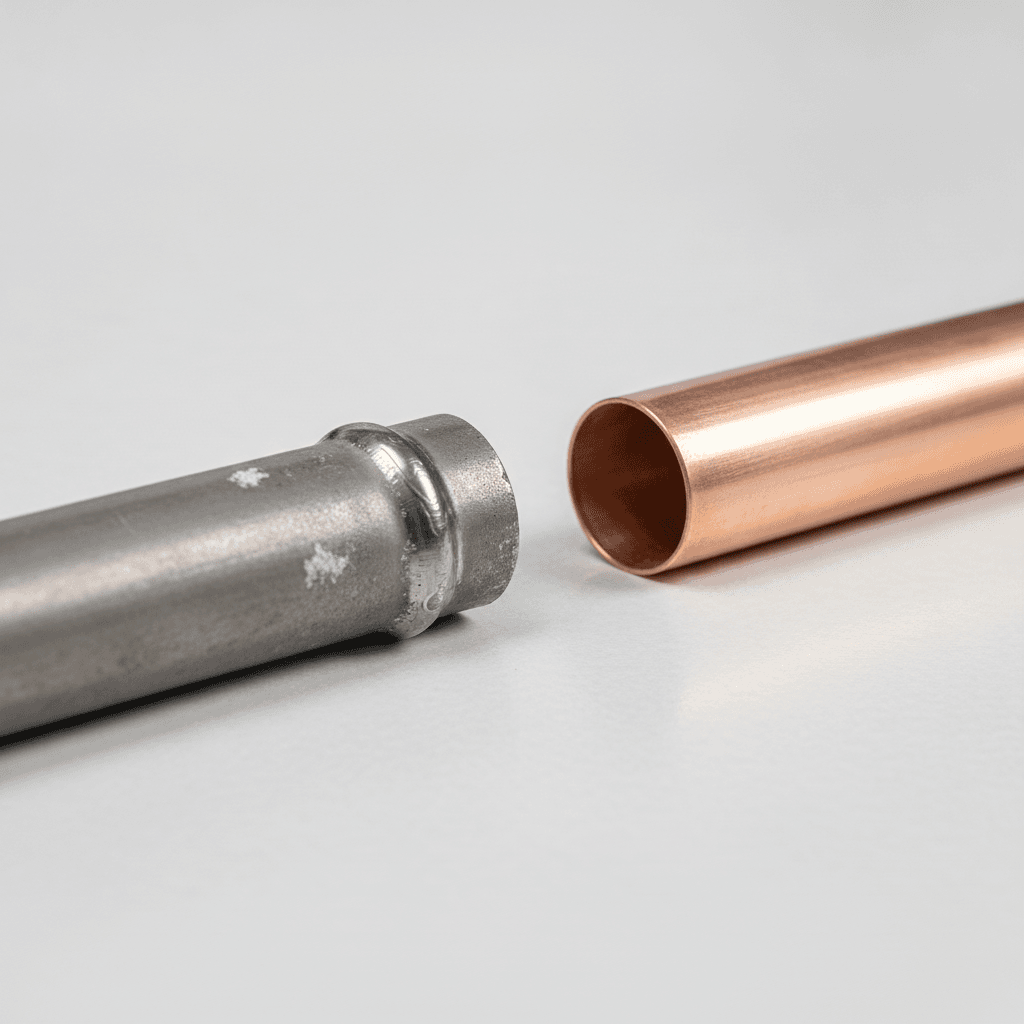
Lead pipe is a dull gray, smooth, and often slightly swollen or bulb-shaped where it meets the meter or fittings. Copper looks like a shiny or dull penny. Plastic (PEX or PVC) is obviously not metal. Galvanized steel looks silvery-gray and threaded at the joints.
Lightly scratch the pipe with a key or a coin. If the scratched area turns shiny silver and the metal feels soft, that's a strong sign of lead. Copper will show a copper/bronze color under the scratch.
Hold a refrigerator magnet to the pipe. A magnet will NOT stick to lead (or to copper). A magnet WILL stick to galvanized steel. So: shiny-silver scratch + soft metal + no magnet = likely lead. No magnet but penny-colored scratch = copper.
| Pipe Material | Scratch Test | Magnet Sticks? | Appearance |
|---|---|---|---|
| Lead | Shiny silver, soft | No | Dull gray, smooth, often bulb at fittings |
| Copper | Penny/bronze color | No | Looks like a copper penny |
| Galvanized steel | Gray, hard | Yes | Silvery-gray, threaded joints, may be rusty |
| Plastic (PEX/PVC) | N/A | No | White, blue, red, or cream plastic — clearly not metal |
Galvanized steel matters too. Under the new rule, galvanized pipe that is or ever was downstream of a lead line is classified as “galvanized requiring replacement” (GRR), because it can trap and release lead particles. If your line is galvanized, don't assume you're in the clear — have it evaluated.
Is My Northeast Ohio Home at Risk?
The single biggest predictor is age. Lead service lines and lead solder were widely used until the federal lead ban took effect in 1986. If your home was built before then — and a huge share of the housing stock in Warren, Youngstown, Niles, Hubbard, and Liberty was — lead is a real possibility worth ruling out.
A lead service line or lead solder is a real possibility. Worth a five-minute check.
Need a Plumber or Waterproofing Expert?
Our team is available 24/7 for emergencies. Call now or schedule online.
Lead service lines are unlikely, but lead solder on copper joints is still possible.
Lead-free materials were the standard by this point.
Northeast Ohio's older neighborhoods — the brick streets of Warren, the century homes around Youngstown, the post-war builds in Cortland and Howland — are exactly the kind of housing where lead service lines turn up. That's no cause for alarm, but it's worth five minutes to rule out.
What to Do If You Have — or Might Have — Lead
There's no safe level of lead in drinking water, and the risk is highest for infants, young children, and pregnant women. The good news is that the steps to protect your household are simple and inexpensive while you sort out a permanent fix.
Interim Protection Steps
A filter or a flush is a stopgap, not a cure. The only permanent solution is getting the lead pipe out of the ground. If you want longer-term peace of mind on water quality, a whole-home water treatment and filtration system can add an extra layer of protection — but it's a complement to line replacement, not a replacement for it.
What Your City Covers, and What It Doesn't
If the scratch and magnet tests point to lead, call your water department first. Cities in our area are using state and federal funds to replace lead lines, and some will replace the part on your property at no cost to you. Here is what we know as of September 2026:
Youngstown Water offers a Customer-Owned Service Line Replacement Agreement. If city records show your line is lead or galvanized steel, the city will replace your side of the line with copper or plastic for free. The city puts that work at more than $3,000. Read the terms before you decline: if you turn the offer down, future repair and replacement of that line is at your cost. Call Youngstown Water at (330) 884-6005 or see the city's lead service line page.
Warren is part of the EPA's Get the Lead Out initiative and is cataloging every service line in the city. It has not yet published whether it will replace the homeowner's side. Call the Warren Water Department at (330) 841-2531 and ask what your line is recorded as, and what the city will cover. See the city's service line page.
Every public water system had to build a service line inventory and make it available to the public. Search your utility's website for "service line inventory" or call the number on your water bill. If your line is listed as "unknown," ask when they plan to verify it.
Where the city stops
City programs replace the service line, the pipe from the street to your meter. They do not touch the plumbing inside your house. In a home built before 1986, that plumbing can still carry risk after a new service line goes in:
- Galvanized steel pipe. Old galvanized pipe that sat downstream of a lead line can hold lead in its corroded lining and release it later.
- Lead solder. Copper pipe joined before the 1986 lead ban often has lead solder at the joints.
- Old fixtures and valves. Older faucets and brass fittings can contain lead.
Some homes are not covered at all: homes on a private well, homes outside a city water program, and owners who declined the city's offer. Those owners pay a plumber to replace their side of the water line.
That is where we come in. We can confirm what your service line is made of, check the pipe inside your house, and give you upfront pricing before any work starts. If your interior plumbing needs it, repiping replaces the old galvanized or lead-soldered pipe with copper or PEX. While you wait on the city, a certified water filtration system is a good interim step. We have been working on older Trumbull and Mahoning County homes since 2020, and we know what is in the walls here.
Frequently Asked Questions
It depends on where you live. Youngstown Water offers free replacement of the homeowner's side of a lead or galvanized line when city records flag it; call (330) 884-6005. Warren has not yet published whether it covers the homeowner's side; call (330) 841-2531. In other towns, call the number on your water bill. Always check with the city before you pay anyone to replace a service line.
The legal mandate is on your water utility, not on you directly. The utility is required to inventory and replace lead service lines, and in many communities that includes help with the private side. That said, the portion of the line on your property is your responsibility to maintain, and full replacement is what actually removes the lead — so ask your water department what it will cover before you hire anyone.
Under the LCRI, water systems must replace virtually all lead service lines by November 1, 2037 — a 10-year window from the compliance date of November 1, 2027. Many Ohio systems are moving faster than that using infrastructure funding, so your community's timeline may be shorter.
Yes. Lead is colorless, odorless, and tasteless in water — you cannot see, smell, or taste it. The only ways to know are to identify the pipe material and to test the water. Clear water from a lead service line can still carry lead, especially after sitting in the pipe overnight.
Look for a small round or rectangular metal cap, often cast iron, flush with the ground in the treelawn between the sidewalk and the street — roughly in line with where your water meter sits inside. That cap marks the curb stop, the dividing line between the public and private portions of your service line.
A filter certified to NSF/ANSI Standard 53 for lead reduction is a solid interim measure and protects you at the tap, as long as you replace the cartridge on schedule. But it doesn't remove the lead pipe, and an expired or uncertified filter can give false confidence. Treat filtering as protection until the line is replaced, not a permanent fix.
Not necessarily. Galvanized pipe that is or ever was connected downstream of a lead line is classified under the new rule as “galvanized requiring replacement,” because it can absorb and later release lead particles. If your service line is galvanized, have it evaluated rather than assuming it's safe.
Yes. We can inspect the service line where it enters your home, confirm the material, and explain your options for replacing the private side — including coordinating with your local utility's lead line program. Call us at (330) 574-1507 to set it up.
Not Sure What's Bringing Water Into Your Home?
AK Water Works inspects, confirms, and replaces aging and lead service lines across Trumbull and Mahoning County — Warren, Youngstown, Niles, Cortland, Howland, Boardman, Canfield, and beyond. Get a clear answer and a straight estimate from a local, family-owned plumber.
Schedule a Service Line Inspection Call (330) 574-1507
24/7 Emergency Service • BBB A+ Accredited • 4.9 Stars / 1,055+ Reviews • Family-Owned Since 2020 • Licensed, Bonded & Insured
Need Help With Your Plumbing?
Our team is ready to help with any plumbing or waterproofing need.