
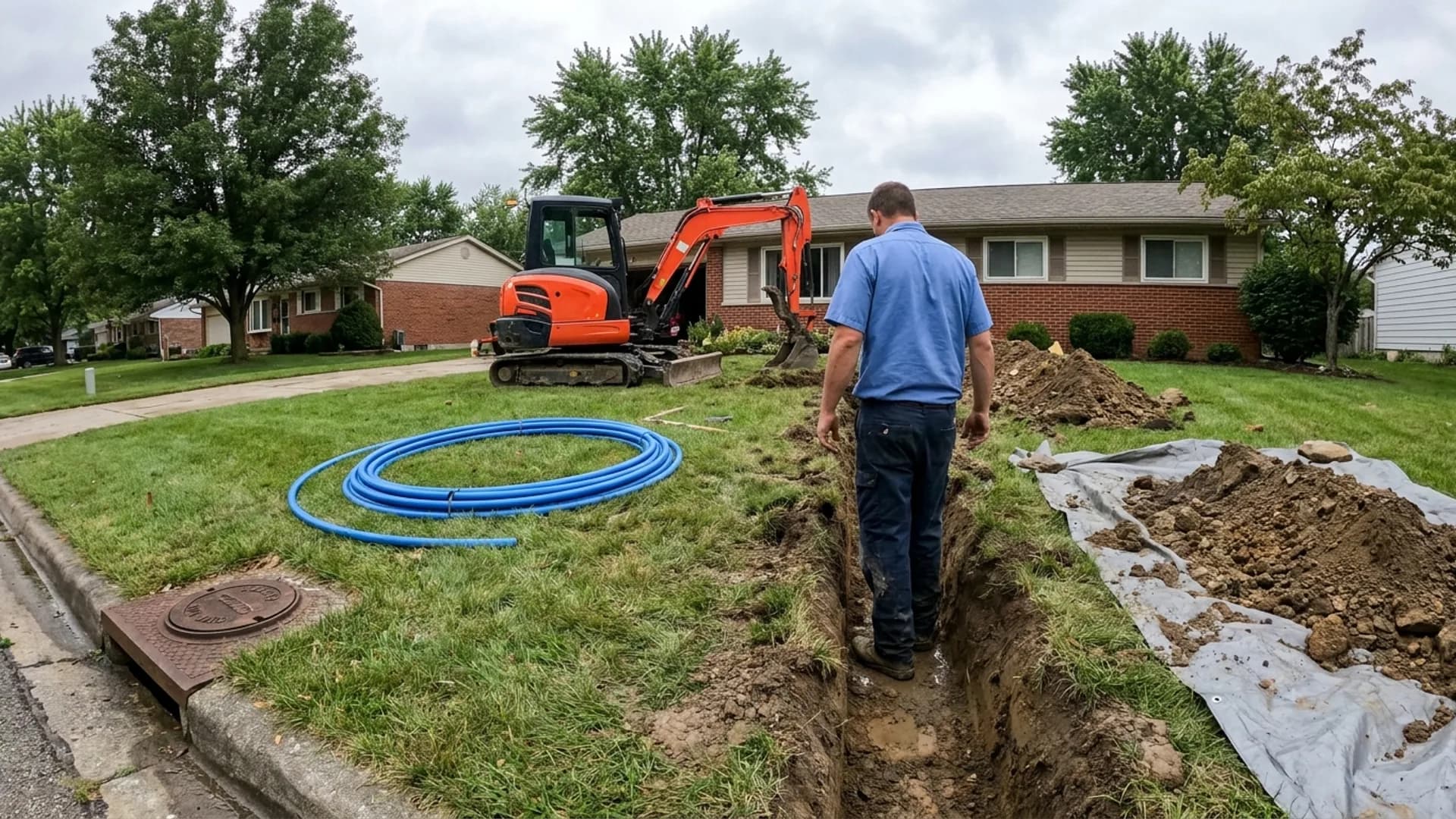
Water Line Repair & Replacement in Northeast Ohio The Buried Line From the Curb Into Your House.
Water line repair covers the buried water service line running from the city main, meter, or curb stop into your house, and that is different work from anything inside your walls. AK Water Works confirms the break with a meter and pressure test, tells you whether trenchless replacement or an open-cut trench is the right call for your property, pulls the permit, and gets your water back on.
Serving Warren, Youngstown, Boardman, Niles, and communities across Trumbull, Mahoning, Portage, and Columbiana counties. Licensed Ohio plumbers, upfront pricing before anything gets opened up. Call (330) 574-1507.

A water line repair is outside work. The water service line is the single buried pipe that carries all of your water from the city main to the house, which is why a failure there shows up as low pressure everywhere at once instead of at one sink. AK Water Works repairs and replaces those lines across Northeast Ohio, including trenchless replacement when the yard or driveway is worth saving, curb stop and main shutoff work, and cold-weather calls when a service line freezes or splits.
If the problem turns out to be inside the walls instead, that is a different page and a different job. Interior leaks, hidden leak detection, and whole-house repiping live on our pipe repair and repiping page. We test first so you are paying to fix the right pipe.
Our Water Line Repair & Replacement Services
Water Service Line Repair
Spot repair on a break between the curb and the house
Water Service Line Replacement
Full replacement in HDPE or copper, sized to the house
Trenchless Replacement
Pipe bursting and directional boring, no full-yard trench
Curb Stop & Main Shutoff
Frozen, buried, or broken shutoff valves
Line Locating & Leak Testing
Meter and pressure testing to confirm it is the service line
Frozen & Burst Service Lines
Winter no-water calls and cold-weather breaks
Water Service Line Work We Handle
Repair, trenchless and open-cut replacement, curb stop and shutoff valves, frozen line calls, and permitted right-of-way excavation.
- Water line repair
- Water service line replacement
- Main water line repair
- Trenchless water line replacement

Lost Pressure Everywhere at Once?
That points outside, not inside. We test the meter before we dig.
Why Homeowners Call Us
Signs Your Water Service Line Is Failing
Who Owns the Water Line, You or the City?
This is the first question worth answering, because it decides whose bill it is. In most municipalities the split falls at the curb stop or the property line: the water department owns the main and the tap and commonly the piece out to the curb stop, and the homeowner owns everything from there into the house. It varies by city, so we confirm with your water department before anyone starts digging.
Usually the utility
The water main in the street, the tap into that main, and in most cities the short run out to the curb stop. A break in the road or a street-side main break is normally a call to the water department, not to a plumber.
Usually the homeowner
The service line from the curb stop or property line, across the yard, through the foundation, to the main shutoff inside. A wet spot in your own yard is almost always on your side of that line, which is why it is almost always your repair.
Why it shows on your bill
A leak past the meter is metered water you never used. It runs day and night, which is why a service line leak usually announces itself as a bill that doubled with nothing new happening inside the house.
Ownership boundaries differ between cities, villages, townships, and private water systems. We verify with your specific water department as part of the visit.
Trenchless or Open-Cut? Both Have a Right Answer
Trenchless replacement
Pipe bursting pulls a new line along the path of the old one. Directional boring steers a new path underground. Either way we open a pit at each end instead of trenching the whole run, so the lawn, the sidewalk, and the driveway stay intact.
Best when:
- The line runs under a driveway, walk, or mature landscaping
- The existing path is intact and locatable
- The run is long and the soil cooperates
- Restoring the surface would cost more than the pipe
Open-cut excavation
A conventional trench along the line. It gets a bad reputation it does not always deserve. When the ground is already open lawn, open-cut is often faster, cheaper, and lets us see and verify every foot of the new line.
Better when:
- The old line has collapsed or cannot be traced
- The path bends, changes depth, or runs under a slab or wall
- Rock, old fill, or debris would stop a bore
- The run is short and crosses open lawn
We will not sell you trenchless on a site that does not suit it. We walk the path, look at what is on top of the line, and quote the method that actually fits your property.
What Makes Water Lines Different Around Here
Old pipe under old neighborhoods
Housing stock across the Mahoning Valley is old, and so is a lot of the pipe feeding it. Galvanized steel, copper, and late-1970s polybutylene all show up in service lines here. East Liverpool is a documented local case: the city publishes that service lines at addresses recorded during its 1991 meter change-out were noted as lead or galvanized, so an address check is worth doing there. Elsewhere, the only way to know is to look at what comes out of the ground.
Frost gets deeper than people think
A long January cold snap drives frost well below the depth homeowners assume is safe, especially under a plowed driveway where the snow cover that would have insulated the ground is gone. Shallow lines and lines backfilled with rock are the ones that freeze first. Some thaw out fine. Some split, and you find the break when the yard turns soft in the spring.
Permits and the right-of-way
Water service replacement is permitted work in nearly every city and township we serve, and cutting into a tree lawn, sidewalk, or road usually means a separate right-of-way permit and a restoration requirement on top of it. We pull the permits, schedule the inspection, and restore the surface. Skipping that step is how a repair becomes a title problem later.
How a Water Line Call Goes
Isolate & Test
Close the house valve, watch the meter, pressure test
Locate the Break
Trace the path and narrow it to a spot, not a trench
Pick the Method
Trenchless or open-cut, priced upfront, permit pulled
Replace & Restore
New HDPE or copper, pressure checked, surface put back
Jack says: "If the pressure dropped at every faucet in the house on the same day, stop looking under the sink. Look at the yard."
Common Questions
Who pays for a water line repair, me or the city?
In most municipalities the homeowner owns the water service line from the curb stop or property line into the house, and the water department owns the main plus the tap and often the portion out to the curb stop. That means a leak in your yard is usually your bill, and a leak in the street is usually theirs. It does vary by city, so before we dig we confirm the ownership line with your water department and tell you exactly which side of it the break is on.
How do you know the leak is in the water line and not inside the house?
We test instead of guessing. First we shut the main valve inside the house and watch the meter: if the meter is still turning with the house isolated, the water is being lost between the meter and that valve, which points to the service line. We also pressure test the line and use locating and leak correlation equipment to narrow the break to a spot rather than trenching the whole run. If the meter stops, the problem is inside, and that is interior pipe repair instead.
Can you replace a water line without digging up my whole yard?
Often, yes. Trenchless replacement pulls a new line along the existing path using pipe bursting, or bores a new path with directional boring, so we only open a pit at each end instead of a trench from the curb to the house. That is what saves a driveway, a sidewalk, or a landscaped yard. It is not always the right call though. If the old line has collapsed, changed direction, sits under a slab or a retaining wall, or runs through rock or heavy debris, an open-cut trench is faster, cheaper, and more reliable. We look at the path first and tell you which one your property actually calls for.
What is a curb stop and why does it matter?
The curb stop is the shutoff valve buried in a small vertical box near the street or property line, and it is the valve used to turn your water off outside the house. Two things go wrong with it: the box gets buried or paved over so nobody can find it, or the valve itself seizes and will not close. Either one turns a straightforward repair into an emergency, because there is no way to stop the water while we work. We locate and repair curb stops and main shutoffs, and coordinate with the water department when the valve is on their side of the line.
What is my water line made of, and what do you replace it with?
Older service lines in this area are usually galvanized steel, copper, or, in homes from the late 1970s and 1980s, polybutylene. Galvanized lines corrode shut from the inside and choke your pressure long before they leak. Polybutylene fails at the fittings. East Liverpool is one local case where the city itself publishes that service lines at addresses documented during its 1991 meter change-out were recorded as lead or galvanized, so if you are in that area it is worth checking your address in the city material inventory. We replace with HDPE or copper, both of which are rated for direct burial and outlast what is usually coming out of the ground.
Do frozen water lines actually break underground?
Yes, and it is one of the most common reasons we get called out here in January and February. Frost drives deeper in a long cold snap than most people expect, and a service line that was buried shallow, was backfilled with rock, or runs under a plowed and salted driveway can freeze even though it never froze before. Sometimes it thaws and the line is fine. Sometimes the ice split the pipe and you find out when the ground thaws and the yard turns to mud. Either way, no water in a freeze is a call worth making right away rather than waiting it out.
Do I need a permit to replace a water line?
Almost always. Water service work is permitted work in nearly every city and township we serve, and if the excavation crosses a sidewalk, tree lawn, or road right-of-way there is usually a separate street-opening or right-of-way permit too. We pull the permits, schedule the inspection, and handle the restoration requirements. Anyone offering to skip the permit is handing you the problem at resale.
What does water line replacement cost?
It depends on the length of the run from the curb to the house, the depth, what is on top of it, and whether the job goes trenchless or open-cut. A short run through open lawn is a very different job than a long run under a concrete driveway. We test to confirm the break, walk the path with you, and give you a firm price before anything gets opened up. Financing is available on full replacements. Call (330) 574-1507 and we can usually get out the same day on a no-water call.
Related Plumbing Services
Recent Water Line Work Across Northeast Ohio
Completed a main water service valve job near Helena Dr in Struthers. The main water service valve controls your home's entire water supply.
Completed a main water service valve job near Sunny Dr in Girard. The main water service valve controls your home's entire water supply.
Completed a exploratory dig(water main) job near Market St in North Lima. Excavate down approximately 7 ft long, 3 ft wide, and up to 6 ft deep.
Completed a main water service valve job near Stewart Ave NW in Warren. The main water service valve controls your home's entire water supply.
Completed a main water service valve job near Como St in Struthers. The main water service valve controls your home's entire water supply.
Completed a main water service valve job near Bittersweet Dr NE in Howland. The main water service valve controls your home's entire water supply.
Get the Water Back On
Wet spot in the yard, a bill that doubled, or no water after a freeze. Call and we will test before we dig.